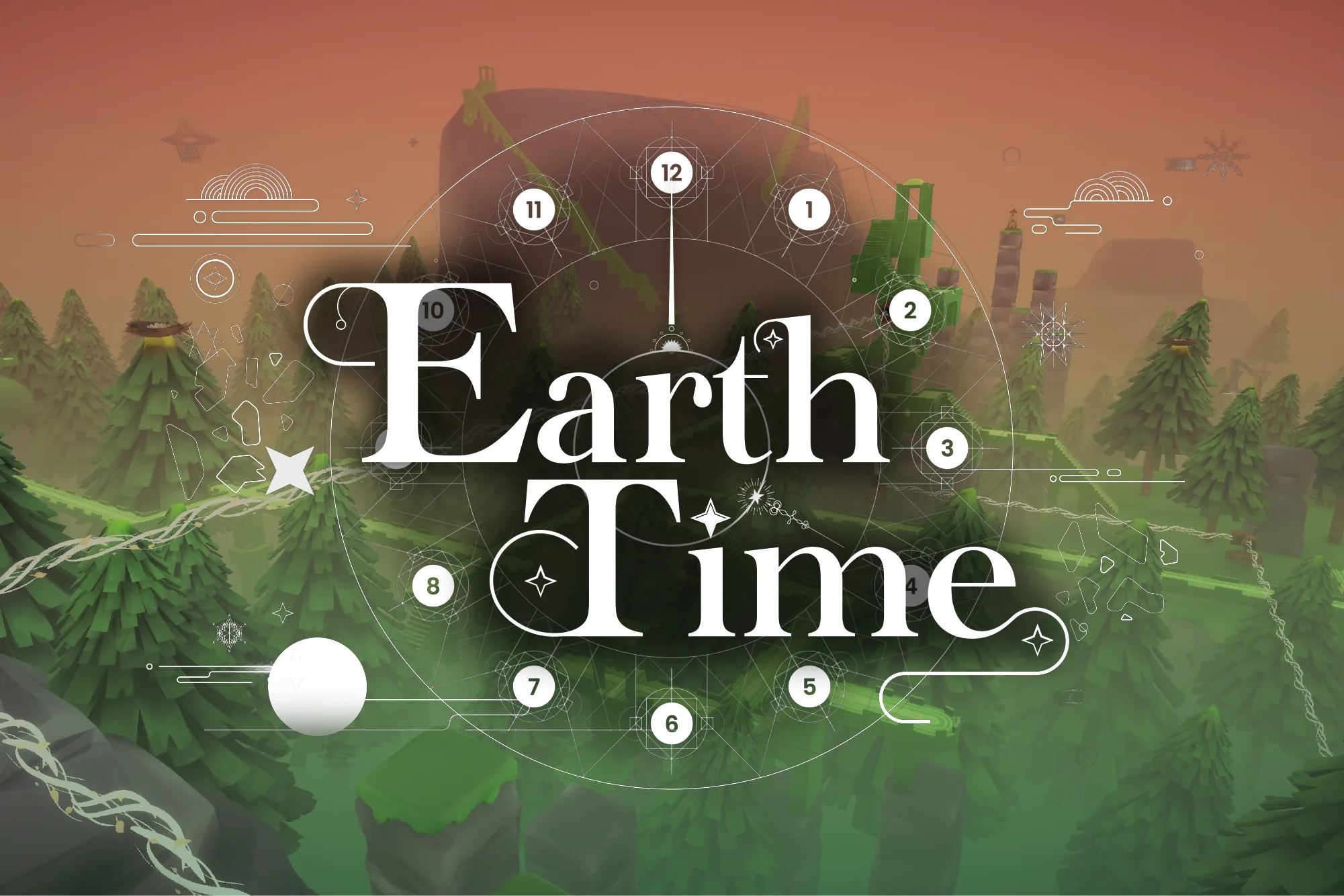
EarthTime
A large-scale touchscreen game for The Cube that helped visitors explore how Earth's rotation, natural systems and atomic time connect.
Overview
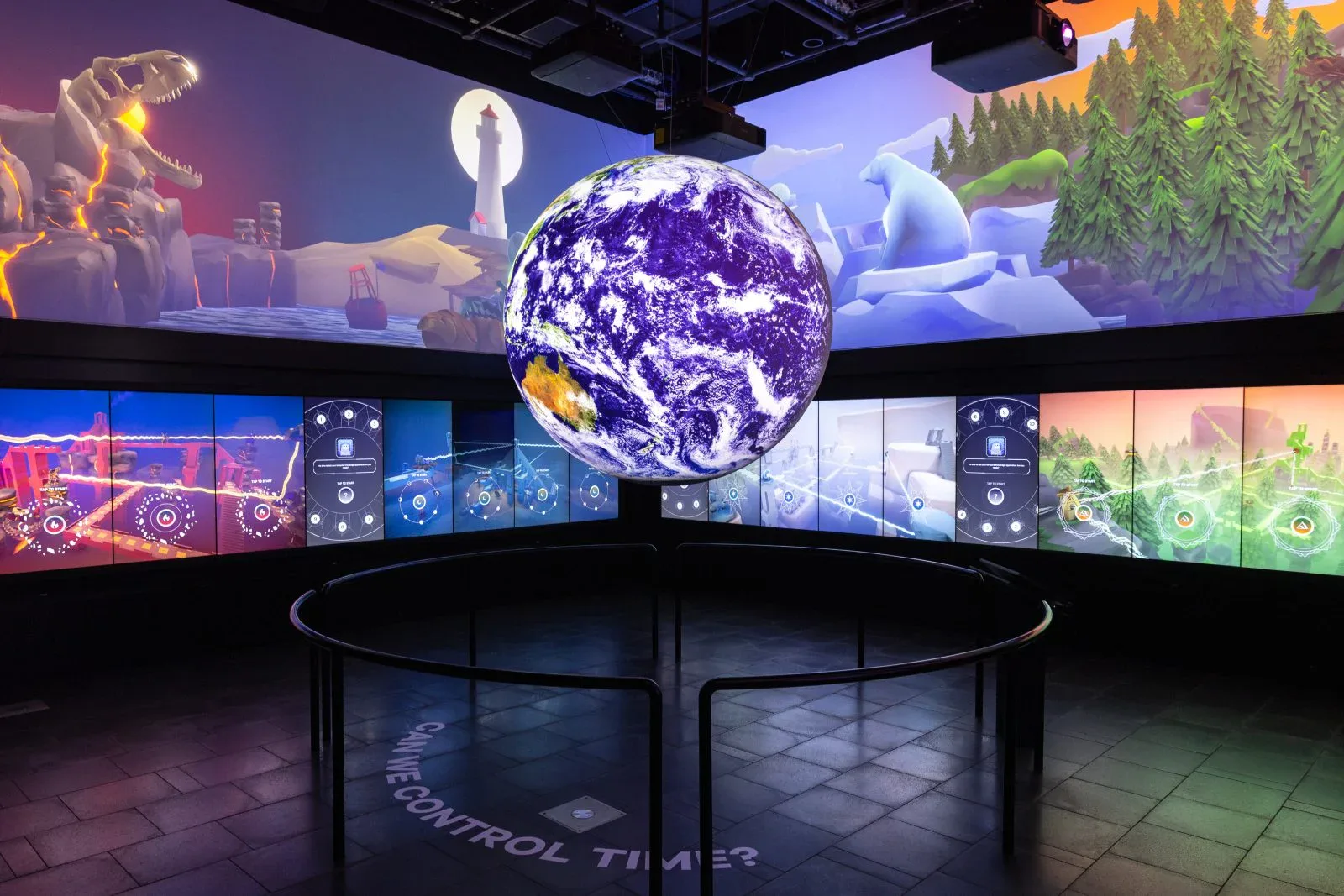
EarthTime was a QUT VISER project developed in collaboration with MOD. for the 2025 Forever exhibition. It was designed as a public touchscreen interactive for The Cube: a lightweight, casual game that could look strong on large screens while still connecting to real scientific ideas about time.
The experience asks visitors to help the Time Keeper, Clockwork Larry, align Earth's rotation with atomic time. Visitors move between five Time Alignment Temples, solving puzzles that represent different forces known to affect Earth's rotation.
Challenge
The brief had two sides. On one side, the experience needed to be fun, visual and easy for casual visitors to understand quickly. On the other, it needed to connect to real theory: Earth's rotation is not perfectly constant, and natural systems can slow it down or speed it up.
The challenge was to turn complex ideas about solar days, atomic time, deep time, tides, melting ice, Earth's interior, atmosphere and relativity into a public-facing game that could be understood through action rather than explanation alone.
The experience
Visitors enter a playful crisis: the atomic clock is out by one second, and the Time Alignment Temples need to be stabilised. Each temple represents a different factor that affects time or Earth's rotation.
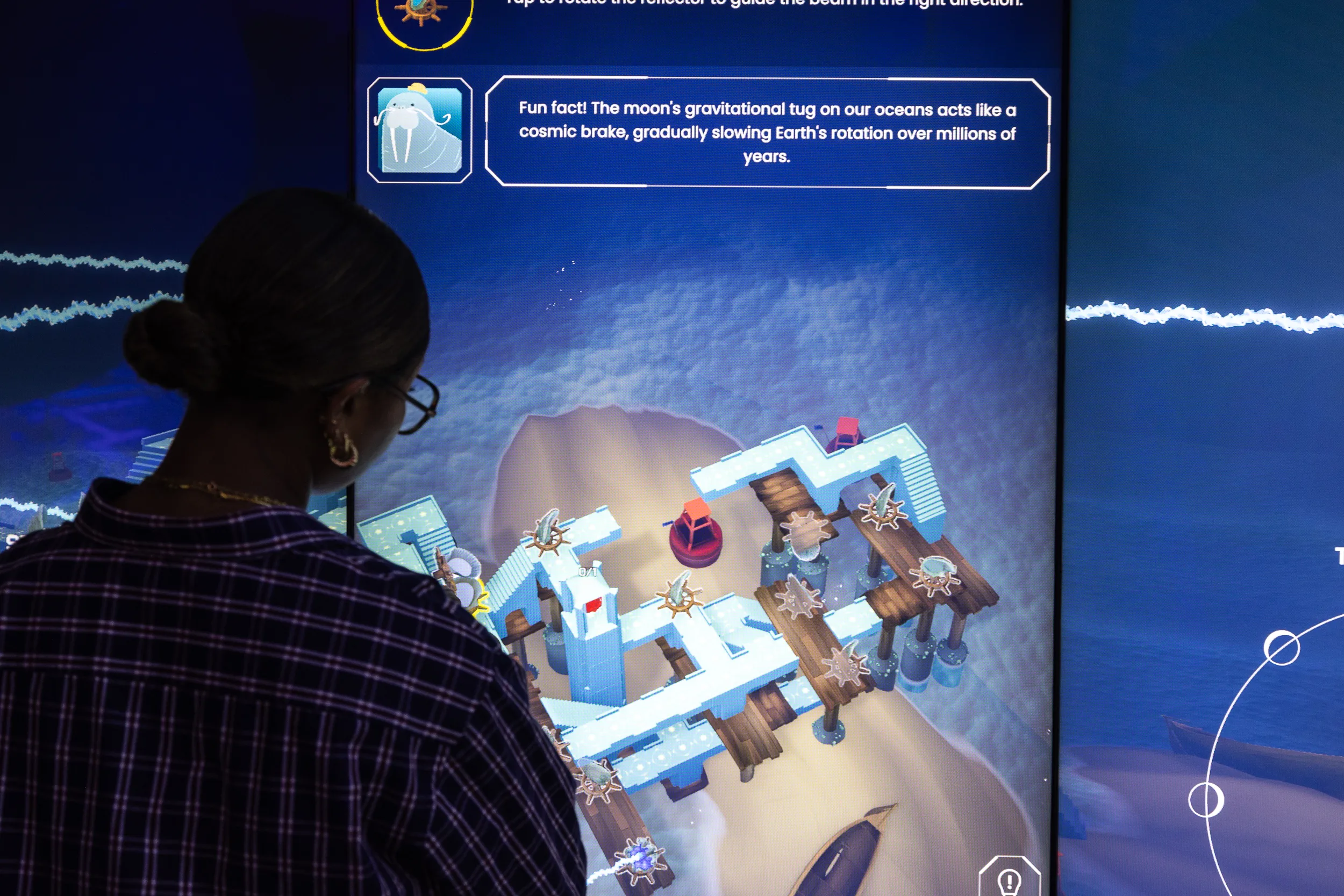
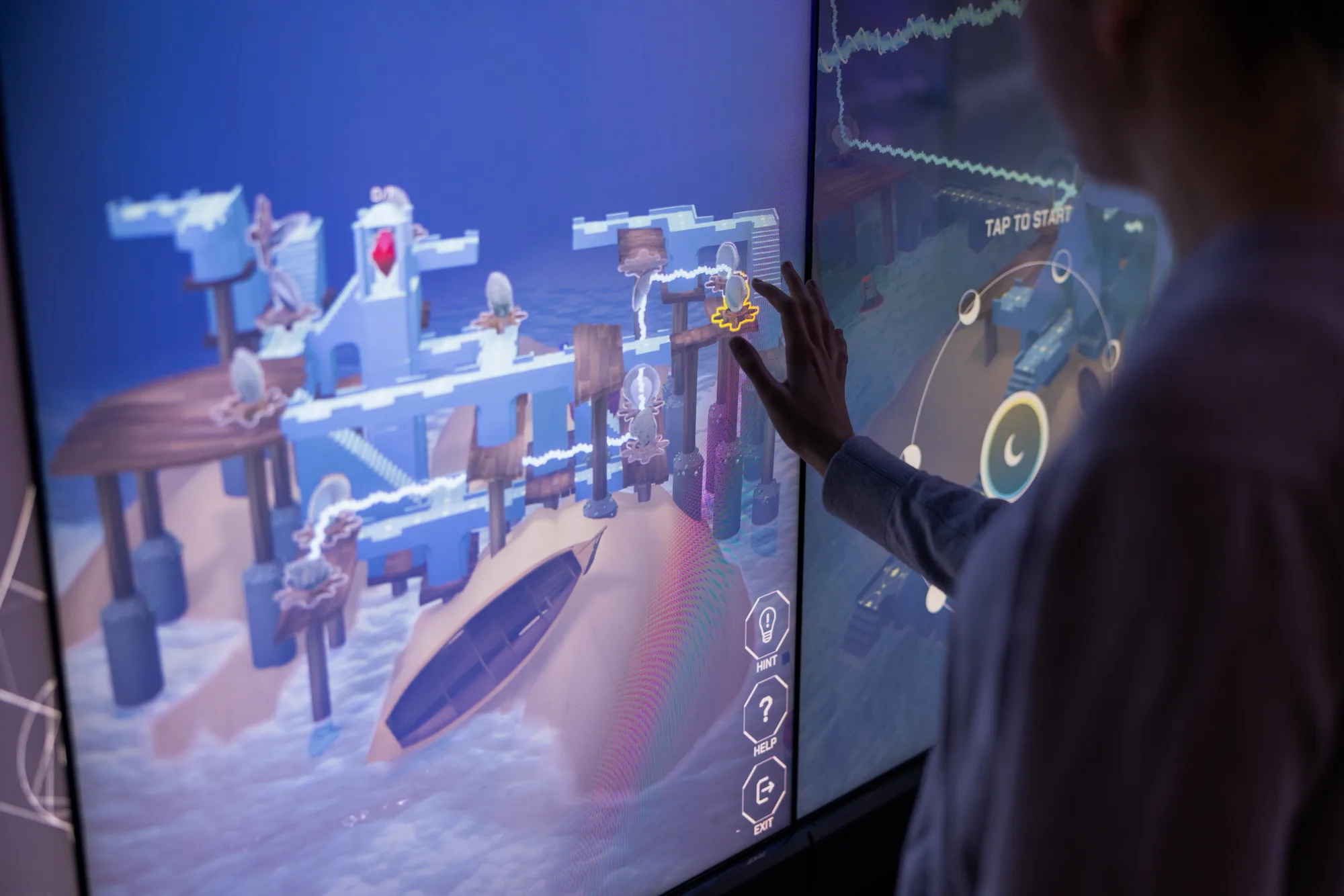
In the Subterranean Temple, the movement of Earth's core and mantle can shift rotation. In the Polar Temple, melting ice changes the distribution of mass. In the Ocean Temple, the Moon's pull on tides acts like a brake. Other temples connect to mountains, atmospheric forces, space, relativity and GPS.
The experience turns these ideas into puzzles, giving visitors a light way to explore the science through interaction.
My role
I contributed as part of the QUT VISER design team. My role focused on the design of the experience: helping interpret the brief, shape the interaction, and support the translation of scientific ideas into a game that could work for casual public engagement on The Cube's screens.
What I designed / contributed
- Experience design
- Game concept and interaction design support
- Translating learning objectives into public interaction
- Supporting the structure of the five-temple puzzle system
- Designing for large-scale screen and touchscreen use
- Balancing scientific content with casual visitor engagement
- Visual and interaction direction as part of the design team
What this shows
EarthTime shows how a complex topic can be made more accessible through interaction. Instead of asking visitors to read a long explanation of Earth's rotation and atomic time, the experience gives them a role, a problem and a set of actions.
It is a strong example of experiential learning: the science is still present, but the visitor encounters it through play, movement, visual feedback and puzzle-solving.
Relevance now
EarthTime connects directly to my current practice because it sits at the intersection of learning, public interaction and structured experience design. It shows the same underlying question at a larger institutional scale: how can interaction help someone understand a complex idea more clearly?
EarthTime helped broaden the practice beyond AR by showing how a digital layer can also be a large-scale public game. The interaction, visual feedback and touchscreen format were chosen because they suited the learning goal, the physical environment of The Cube and the casual visitor context.
The current guided digital experience work is usually lighter and mobile-first, but the principle is the same: use structure, context and interaction to make difficult ideas easier to enter.
Project Images